

Designing an AI-Enabled, Multi-Actor Risk-Intelligence Platform for Modular Construction
Project Vision
ModuRisk is designed to become the first collaborative risk intelligence platform purpose built for modular construction. The goal is to give developers, factories, lenders, insurers, government, and design partners the ability to make clearer and more risk adjusted decisions at every stage of a project. The platform turns fragmented and expertise heavy risk assessment into an intuitive and AI enabled workflow that surfaces actionable insights, reduces uncertainty, and improves cost, schedule, and quality outcomes.
My Role
I was responsible for designing the end to end user experience and product architecture that supports this vision. This included developing the modular construction risk ontology, conducting UX research, mapping multi actor workflows, building the business and technical architecture, designing wireframes and prototypes, and shaping next generation AI capabilities related to document parsing, risk identification, and collaborative decision making. On top of the research, I decided what information should be on the public website, as well as the brand identity. I also created an in depth playbook for seven different actors that outlines their motivations, workflows, required decisions, and the value they derive from the platform.
Key Challenges
1)
Researching and designing for 7 actors
2)
Low engagement in initial Pilot launch
3)
Balancing Transparency and Cognitive Load
4)
Creating a playbook for users
5)
Aligning Business Value with Technical Architecture
Research
I conducted in depth research in close collaboration with the company founder, an expert in risk management and insurance, to ground the platform in real world decision making and industry practice. This work focused on understanding the goals, challenges, incentives, and risk perceptions of key actors across the modular construction ecosystem, including developers, factories, lenders, insurers, government stakeholders, architects, and engineers. I researched and mapped end to end workflows using frameworks such as ETVX and ADKAR to identify how risks are currently evaluated, communicated, and mitigated across project phases. This research informed the definition of user needs, decision points, data inputs, and handoffs between actors, and directly shaped the platform’s risk ontology, user experience, and collaborative workflow design.
Currently, we are working on Gen 2 of ModuRisk, where we are putting an emphasis on stronger AI to complete tasks like Document Parsing, Risk Suggestions, Project Evaluation, etc. I am an eager to learn more about AI integration in products, as I believe it can greatly improve the UX.
"Who will benefit from the app?"
"How can users complete their goal?"
"How is risk management currently practiced in the housing industry. How can we improve it?"
"What tasks can AI help with?"
"What are the goals/incentives for each user?
"What are some challenges?"

Meet All 7 Users

Alex
Age: 42
Occupation: Developer
Alex oversees modular housing projects from feasibility through delivery. He is responsible for managing cost, schedule, and risk across multiple partners while securing financing and approvals.
Pain Points: Limited visibility into downstream risks, fragmented information from partners, and difficulty proving risk readiness to lenders and insurers.
Looking to Solve: Early risk visibility, clearer accountability across partners, and stronger confidence when making investment and scheduling decisions.

Sarah
Age: 45
Occupation: Policy Analyst for Government
Sarah reviews modular housing projects for compliance, funding eligibility, and public risk exposure.
Pain Points: Difficulty understanding project level risks, limited insight into execution readiness, and inconsistent reporting from proponents.
Looking to Solve: Clear, structured risk summaries that support faster review, better policy decisions, and reduced public exposure.

Priya
Age: 38
Occupation: Lender
Priya evaluates construction loans for modular projects and must assess financial, execution, and counterparty risk before approving funding.
Pain Points: Inconsistent risk documentation, reliance on developer provided information, and lack of standardized risk signals for modular construction.
Looking to Solve: Reliable risk indicators, improved transparency across project phases, and better confidence in underwriting modular projects.

Daniel
Age: 47
Occupation: Architect
Daniel designs modular buildings and coordinates with developers and factories to ensure designs are buildable and compliant.
Pain Points: Late discovery of constructability issues, unclear downstream impacts of design decisions, and limited feedback from manufacturing and site teams.
Looking to Solve: Early identification of design related risks and better alignment between design intent and execution constraints.

Michael
Age: 51
Occupation: Insurance Underwriter
Michael assesses insurance coverage and pricing for complex construction projects, including modular builds.
Pain Points: Limited insight into project specific risk controls, late visibility into design and manufacturing risks, and uncertainty around responsibility allocation.
Looking to Solve: Earlier access to risk information, clearer mitigation strategies, and improved alignment between insured parties.

Elena
Age: 44
Occupation: Structural Engineer
Elena is responsible for ensuring structural integrity and regulatory compliance across modular systems.
Pain Points: Incomplete information from other stakeholders, unclear responsibility boundaries, and pressure to approve designs with limited context.
Looking to Solve: Better visibility into project assumptions, interfaces, and risk dependencies across disciplines.

Lucas
Age: 46
Occupation: Modular Factory Operations Manager
Lucas oversees production scheduling, quality control, and logistics within a modular manufacturing facility.
Pain Points: Design changes late in the process, misalignment between factory capacity and project schedules, and limited visibility into site readiness.
Looking to Solve: Clearer upstream information, earlier risk identification, and better coordination between design, manufacturing, and site delivery.
Wireframes
When I first joined the team, it was very important for me to understand the entire housing ecosystem in Canada. I spent many hours talking with the founder to gain more knowledge and understand the vision of the product. From there I was able to generate wireframes for the public facing website and the content once the user logs in.

Iteration
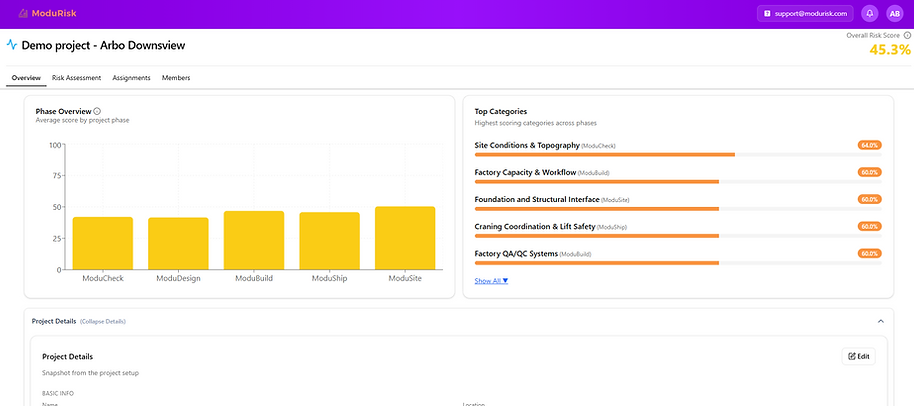
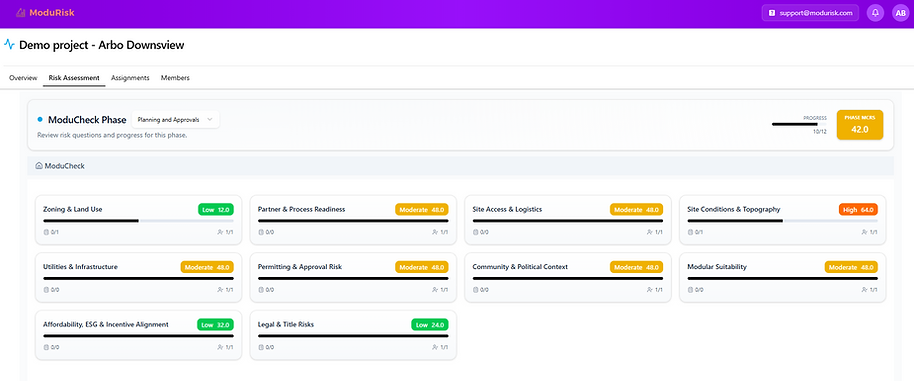
After launching the pilot, we gathered feedback from multiple stakeholders, including developers based in Toronto, government officials, and factory representatives. This feedback revealed that the platform content created significant cognitive overload, indicating a need to simplify information and workflows to improve overall usability and user experience.

Rearrange content.
Based on user feedback, key information was reorganized in a cleaner way, because there was too much clutter, and they rearranges in a more optimal way.

Add Tooltips.
To reduce friction, we added tooltips, for users to learn more about certain functions as they are navigating.

Show less info.
Users expressed they had difficulty focusing on the task at hand because information was too cluttered, we fixed this by simplifying our risk ontology and cleaning up the space.

Improve Navigation.
We changed the user flow so that it made more sense depending on the persona using the platform.
Before User feedback

After User feedback

Playbook
It was important that our pilot participants had a playbook they could refer to so they could understand all of the platform capabilities. The playbook is designed for each actor to navigate their own workflow, as well as understand the benefits of using the product and how it will help the housing industry.

Challenge 1
Researching and Designing for 7 actors
ModuRisk serves a diverse group of stakeholders, each with distinct goals, responsibilities, and risk tolerances. Research focused on understanding how developers, lenders, insurers, government stakeholders, architects, engineers, and factory operators perceive and manage risk across project phases. These insights informed role specific workflows, permissions, and content structures that allow each actor to engage meaningfully with the platform without being exposed to irrelevant or unnecessary complexity.
Challenge 3
Balancing Transparency and Cognitive Load
Providing full visibility into project risks is essential for trust and decision quality, but early versions of the platform overwhelmed users with too much information at once. The challenge was to balance transparency with usability by prioritizing high impact risks and introducing progressive disclosure. This ensured that users could access deeper detail when needed without being forced to process all information upfront.
Challenge 2
Low engagement in initial Pilot Launch
The initial pilot revealed low engagement with manual risk assessment workflows, particularly when users were asked to complete long and detailed inputs. Feedback indicated that users lacked both the time and motivation to perform exhaustive risk entry, especially when the immediate value was not clear. This highlighted the need to rethink how risk data is surfaced, reduce friction, and explore AI enabled approaches that shift effort away from users while still capturing critical insights.
Challenge 4
Creating the Playbook for each Actor
To support consistent adoption and shared understanding, I created an in depth playbook for each of the seven actors on the platform. These playbooks outline actor specific goals, responsibilities, decision points, and how each role derives value from collaborative risk intelligence. The playbooks served as both an onboarding tool and a design reference, ensuring that product decisions remained aligned with real world workflows and incentives.
Brand Identity
As part of the early product work, the founder gave me the opportunity to define key elements of ModuRisk’s brand identity, including the design of the public facing homepage and the selection of the primary color palette. Orange was chosen to reflect the construction industry, activity, and progress, while blue was selected based on color psychology research that associates it with professionalism, safety, and protection. These qualities closely align with ModuRisk’s role in helping stakeholders manage risk, build trust, and make informed decisions across complex modular construction projects.


Takeaways
Working at ModuRisk has given me end to end exposure to designing and building a complex, multi actor product within a live startup environment, and I continue to contribute as the platform evolves. I have learned how to lead UX efforts in close partnership with the founder and a full stack development team, balancing product vision, technical constraints, and real world user needs. My work includes ongoing stakeholder research across developers, lenders, insurers, government, design professionals, and factory operators to understand how risk is perceived and managed across the modular construction ecosystem.
I translated early concepts into user flows and wireframes to establish a shared baseline for the founder’s vision and support iterative development. Working closely with a full stack developer on a daily basis strengthened my ability to design within technical constraints while ensuring the product remains functional, scalable, and user friendly. I also created an in depth playbook for pilot users to support onboarding and clarify responsibilities across seven different actors.
Through pilot feedback and user interviews, I identified pain points related to cognitive overload, engagement, and clarity, and iterated on the platform by simplifying workflows, improving navigation, and refining content. I am currently contributing to the development of a second generation of ModuRisk that incorporates stronger AI capabilities to reduce user effort, improve risk identification, and make the overall experience more intuitive and accessible for all stakeholders.